
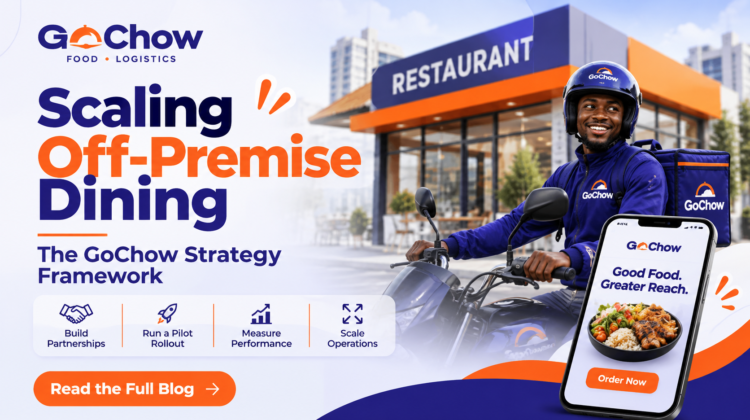
Scaling Off-Premise Dining: The GoChow Strategy Framework
The restaurant industry is changing. Customers no longer depend entirely on visiting physical restaurant locations to enjoy their favourite meals. From office workers ordering lunch to families requesting dinner at home, off-premise dining has become an important part of how Quick Service Restaurants (QSRs) serve their customers.
For restaurant franchises operating multiple branches, this shift creates a significant opportunity. However, expanding delivery operations across several locations requires more than simply making meals available for online orders. It requires a structured approach to logistics, operational consistency, customer experience, and business growth.
This is where GoChow’s strategy framework for off-premise dining comes in.
By combining structured business partnerships, controlled pilot programmes, and operational planning, GoChow aims to help QSR businesses build delivery systems that can grow alongside their operations.
Understanding the Growing Importance of Off-Premise Dining
Off-premise dining refers to restaurant transactions where customers consume their meals outside the restaurant premises. This includes takeaway orders, direct delivery, online food ordering, and other forms of remote food purchasing.
For QSR brands, this presents an opportunity to reach customers beyond the immediate surroundings of their physical locations.
A restaurant in Ikeja, for example, can potentially serve customers working in nearby offices, residents within surrounding neighbourhoods, and people who prefer ordering meals from home.
However, as order volumes increase, operational challenges can also become more noticeable.
Some common challenges include:
- Delivery coordination: Managing orders and delivery requests across multiple branches.
- Operational consistency: Maintaining reliable service standards across different restaurant locations.
- Delivery delays: Coordinating dispatch activities to meet customer expectations.
- Cost management: Understanding the operational expenses associated with fulfilling delivery orders.
- Customer experience: Ensuring customers receive accurate orders and timely updates.
For multi-branch QSR operators, these challenges require a coordinated strategy rather than isolated solutions for individual outlets.
The GoChow Strategy Framework for Scaling Off-Premise Dining
Scaling delivery operations should be approached as a business partnership, not simply a transaction between a restaurant and a delivery provider.
GoChow’s proposed strategy framework focuses on four important areas: partnership alignment, pilot implementation, performance evaluation, and structured expansion.
1. Establishing a Master Service Agreement (MSA)
Before launching a delivery partnership, both parties need a clear understanding of their responsibilities.
A Master Service Agreement (MSA) provides a formal structure for the relationship between a QSR business and its logistics partner.
For restaurant groups with multiple branches, this helps establish consistent expectations across participating locations.
An MSA can address areas such as:
- Service coverage and participating restaurant locations.
- Delivery responsibilities and operational expectations.
- Order handling and dispatch procedures.
- Service-level expectations and performance reporting.
- Communication and escalation channels.
- Pricing arrangements and commercial terms.
- Customer service responsibilities.
For QSR management teams, this creates a clearer foundation for coordinating delivery operations across branches.
Rather than negotiating disconnected arrangements for every location, the business can establish a central agreement with provisions for individual branch requirements.
2. Starting With a Controlled Pilot Rollout
One of the biggest mistakes businesses can make when introducing a new operational system is attempting to implement it everywhere at once.
A pilot rollout provides an opportunity to test the proposed delivery arrangement in a controlled environment before committing to wider expansion.
For example, a QSR franchise operating several locations across Lagos could begin with selected branches in Ikeja.
During the pilot, both the restaurant and its logistics partner can assess:
- Order volume and delivery demand.
- Average dispatch and delivery times.
- Rider availability and coordination.
- Order accuracy and fulfilment processes.
- Customer feedback and complaints.
- Operational bottlenecks.
The objective is to understand how the arrangement performs under actual operating conditions.
A pilot also gives management teams an opportunity to identify gaps, refine processes, and make informed decisions before introducing the model to additional branches.
3. Measuring Performance and Improving Operations
A successful pilot should produce useful information that guides business decisions.
Without measurable performance indicators, restaurant operators may struggle to determine whether their delivery arrangements are meeting business expectations.
QSR management teams should consider monitoring key performance indicators (KPIs) such as:
Order fulfilment rate: The percentage of customer orders successfully completed.
Average delivery time: The time between dispatch and successful delivery.
Order accuracy: The percentage of orders delivered correctly.
Customer satisfaction: Feedback relating to food condition, delivery experience, and service reliability.
Delivery cost per order: The average logistics cost associated with fulfilling each order.
Peak-period performance: How effectively delivery operations handle increased demand during busy periods.
These measurements can help identify areas that require improvement.
For example, if a particular branch consistently experiences longer delivery times, management can investigate rider availability, dispatch coordination, order preparation time, or delivery coverage.
The goal is not simply to complete more deliveries. It is to build a system that supports reliable service and sustainable business growth.
4. Scaling Across Multiple Restaurant Locations
Once a pilot has been evaluated and the necessary adjustments have been made, the next step is structured expansion.
Instead of introducing delivery operations across every branch simultaneously, QSR operators can expand in phases.
A phased rollout may involve:
- Identifying branches with strong delivery demand.
- Grouping locations according to geographical proximity.
- Establishing clear dispatch and communication procedures.
- Reviewing performance as new branches are introduced.
- Standardising successful processes across the network.
For businesses operating across different commercial areas in Lagos, location-based planning is particularly important.
A delivery arrangement that works effectively in Ikeja may require adjustments before being introduced in Lekki, Surulere, Victoria Island, or Lagos Island.
By expanding gradually, restaurant operators can maintain better oversight of their delivery operations while identifying location-specific challenges.
Why QSR Franchises Need a Structured Delivery Partnership
For enterprise restaurant groups, delivery is not just another customer service channel. It is an operational function that can influence brand reputation, customer retention, and revenue opportunities.
A poorly coordinated delivery experience can affect how customers perceive the restaurant, even when the food itself meets expectations.
A structured partnership offers several potential advantages.
Greater operational visibility: Clear reporting and agreed performance indicators help management understand how delivery operations are performing.
Consistent service expectations: Centralised agreements can help establish common standards across participating branches.
More controlled expansion: Pilot programmes reduce the pressure of implementing a new arrangement across an entire network at once.
Better coordination: Defined responsibilities and communication channels can reduce confusion between restaurant teams and delivery partners.
Improved decision-making: Operational data can help businesses identify where to invest resources and improve processes.
These benefits depend on effective implementation, ongoing monitoring, and cooperation between the restaurant and its logistics partner.
Building the Future of Restaurant Delivery in Lagos With GoChow
Lagos presents a distinctive operating environment for restaurant delivery businesses. Traffic conditions, customer locations, order patterns, and differences between commercial districts can all influence delivery performance.
For QSR franchises looking to expand their off-premise dining operations, a one-size-fits-all approach may not be sufficient.
GoChow’s approach is built around understanding business requirements, establishing structured partnerships, testing operational arrangements through pilot rollouts, and using performance insights to guide expansion.
Whether a restaurant group is introducing delivery for the first time or looking to improve an existing system, the starting point should be a clear understanding of its operational needs.
Through a structured partnership framework, GoChow aims to support restaurant businesses as they explore more coordinated ways to serve customers beyond their physical locations.
Ready to Explore a Smarter Off-Premise Dining Strategy?
Expanding restaurant delivery operations requires planning, coordination, and the right logistics partnership.
For QSR operators and franchise management teams, the opportunity lies in building a delivery model that can support current demand while remaining adaptable as the business grows.
GoChow is focused on supporting this transition through structured business partnerships and phased operational planning.
Let’s discuss how your restaurant network can build a more coordinated off-premise dining operation with GoChow.
